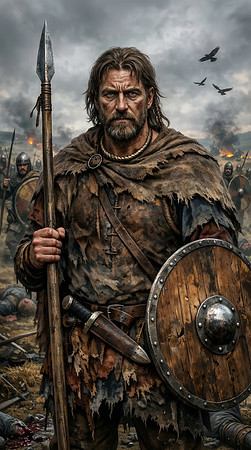
Image generated by AI thanks to
Google Gemini &
Microsoft Copilot.
A rare instance of cross-AI artwork for me nowadays, and I'll be honest in saying it's because I ran out Gemini credits right in the thick of generating these portraits 🤭 So Copilot was my backup plan, and I feel I must show some due appreciation because I have also been using Copilot in the background as a kind of second AI opinion 👍
For example, I was fairly happy with the renders Gemini gave me while it was still working, but there was a little something that looked off. In many cases, it was portraying this Gwenddoleu ap Ceidio with fancy chainmail that seemed ahead of its time. So I asked Copilot for some clarification, and why not recreate the portrait since I was out of Gemini credits?
That's when Copilot offered a grittier, more down-to-earth portrait of Gwenddoleu. In its own words,
What you’re seeing is a deliberately sub‑Roman reconstruction — a war‑leader rather than a medieval monarch. The absence of a crown, the prominence of the spear and shield, the torc as a marker of status, and the rough, layered clothing all reflect what we can reasonably infer about a 6th‑century Brythonic king operating in Yr Hen Ogledd. Gwenddoleu ap Ceidio otherwise piqued my interest as an early Brythonic king who helped to shape British history and inspire Arthurian Legends. He doesn't appear to be well known though, so after getting back in Gemini's good graces and refreshing my credits, I thought to ask:
Can you tell me about Gwenddoleu ap Ceidio in an interesting way? Please include key dates if possible. Here is Gemini's response:
Gwenddoleu ap Ceidio is a fascinating figure because his life sits right on the razor's edge between gritty sub-Roman history and sweeping Arthurian legend. He was a 6th-century Brythonic king of the "Old North" (Hen Ogledd), but his legacy is ultimately defined by his spectacular downfall and the ripples it sent through mythology. Because the historical records and the legendary folklore are so tightly intertwined, here are a couple of different ways to explore his story: Option 1: The Sub-Roman Warlord (The Historical Lens) - The Kingdom: Gwenddoleu ruled Arfderydd (modern-day Arthuret, near Carlisle and Hadrian's Wall). This was a highly strategic territory during the chaotic power vacuum that followed the Roman withdrawal from Britain, putting him in direct competition with other Northern tribal leaders. - Key Date – c. 573 AD: This is the defining year of his life and reign. Gwenddoleu clashed with a powerful coalition of rival Brythonic kings at the bloody Battle of Arfderydd. - The Downfall: He faced an allied force that included the joint kings of Efrog (York), Peredur and Gwrgi, and possibly King Rhydderch Hael of Strathclyde. Gwenddoleu was killed in the slaughter, but his warriors were legendarily loyal. The Welsh Triads list his army as one of the "Three Faithful Warbands of the Island of Britain," noting that his men continued to wage war for a month and a half after their king was slain. Option 2: The Catalyst for Merlin (The Mythological Lens) - The Royal Bard: Gwenddoleu’s closest advisor and chief court bard was a man named Myrddin Wyllt. - The Madness of 573 AD: When Gwenddoleu fell at Arfderydd, the sheer brutality of the massacre broke his bard's mind. Driven mad with grief and trauma, Myrddin fled into the untamed Caledonian Forest to live as a wild man among the animals. - The Arthurian Evolution: In his woodland exile, Myrddin supposedly gained the gift of prophecy. Centuries later, the 12th-century writer Geoffrey of Monmouth took the story of Gwenddoleu's traumatized bard and adapted it, transforming Myrddin into the legendary wizard we now know as Merlin. In a very real sense, without Gwenddoleu's death, the blueprint for Merlin wouldn't exist. - The Magical Hoard: Welsh mythology also claims Gwenddoleu owned a magical chessboard made of gold with silver pieces that played by themselves—an artifact later classified as one of the fabled Thirteen Treasures of the Island of Britain.